About this species
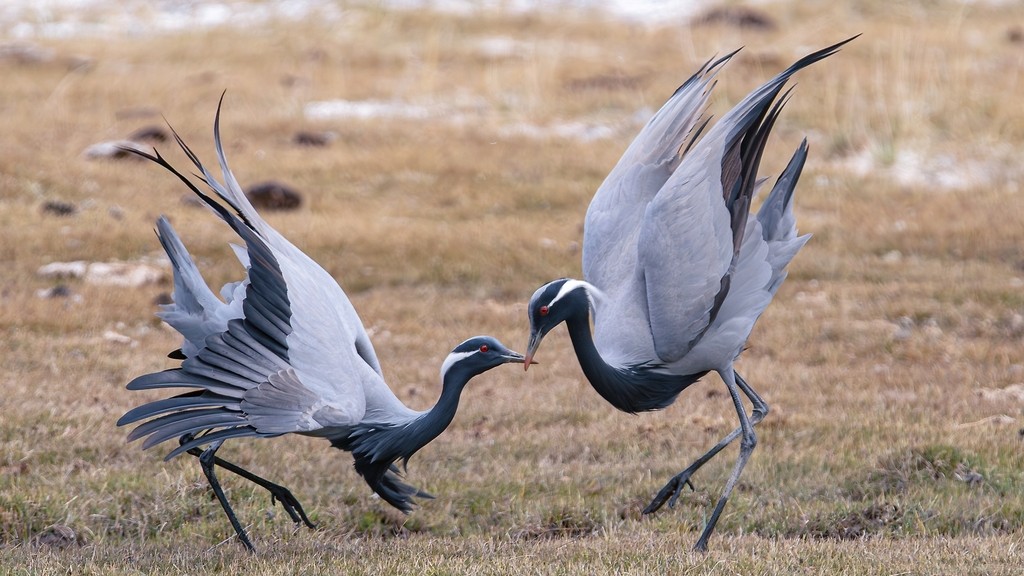
The Demoiselle Crane (Grus virgo) is the smallest crane species, breeding across the grasslands, steppes, and semideserts of Central Eurasia, including much of the Central Asian Flyway (CAF). Within the flyway, it breeds across Kazakhstan, southern Russia, Mongolia, northwestern China, and parts of Central Asia, before migrating south through Afghanistan and Pakistan to winter mainly in India. The species is distinguished by its elegant gray plumage, black head and neck, and striking white ear tufts. It relies on a network of grasslands, agricultural fields, and wetlands along the flyway for migration, stopover, and wintering, feeding primarily on seeds and other plant material supplemented by insects and small vertebrates. It nests directly on the ground in open habitats, usually laying two eggs. Although globally classified as Least Concern with an overall increasing population trend, the species has disappeared from parts of its historical range and continues to face threats from habitat loss and degradation, agricultural intensification, human disturbance, pesticide use, hunting along migration routes, and persecution in areas where it causes crop damage. Long-term monitoring, habitat conservation, and international cooperation across the Central Asian Flyway remain essential for its conservation. The Demoiselle Crane holds cultural significance across Central Asia and the Indian subcontinent, where its annual migrations are celebrated in local folklore and it is regarded as a symbol of grace, fidelity, and safe passage.