
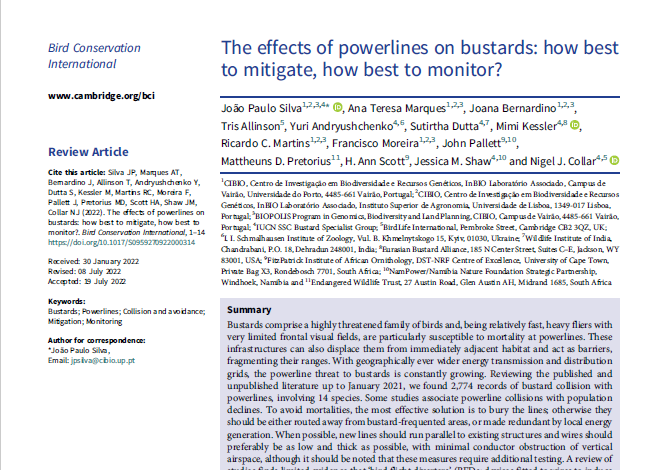
The effects of powerlines on bustards: how best to mitigate, how best to monitor?
João Paulo Silva Open, Ana Teresa Marques, Joana Bernardino, Tris Allinson, Yuri Andryushchenko, Sutirtha Dutta, Mimi Kessler, Ricardo C. Martins, Francisco Moreira, John Pallett, Mattheuns D. Pretorius, H. Ann Scott, Jessica M. Shaw and Nigel J. Collar
Silva, J. P., Marques, A. T., Bernardino, J., Allinson, T., Andryushchenko, Y., Dutta, S., ... & Collar, N. J. (2023). The effects of powerlines on bustards: how best to mitigate, how best to monitor?. Bird Conservation International, 33, e30.
About this resource
Summary: Bustards comprise a highly threatened family of birds and, being relatively fast, heavy fliers with very limited frontal visual fields, are particularly susceptible to mortality at powerlines. These infrastructures can also displace them from immediately adjacent habitat and act as barriers, fragmenting their ranges. With geographically ever wider energy transmission and distribution grids, the powerline threat to bustards is constantly growing. Reviewing the published and unpublished literature up to January 2021, we found 2,774 records of bustard collision with powerlines, involving 14 species. Some studies associate powerline collisions with population declines. To avoid mortalities, the most effective solution is to bury the lines; otherwise they should be either routed away from bustard-frequented areas, or made redundant by local energy generation. When possible, new lines should run parallel to existing structures and wires should preferably be as low and thick as possible, with minimal conductor obstruction of vertical airspace, although it should be noted that these measures require additional testing. A review of studies finds limited evidence that ‘bird flight diverters’ (BFDs; devices fitted to wires to induce evasive action) achieve significant reductions in mortality for some bustard species. Nevertheless, dynamic BFDs are preferable to static ones as they are thought to perform more effectively. Rigorous evaluation of powerline mortalities, and effectiveness of mitigation measures, need systematic carcass surveys and bias corrections. Whenever feasible, assessments of displacement and barrier effects should be undertaken. Following best practice guidelines proposed with this review paper to monitor impacts and mitigation could help build a reliable body of evidence on best ways to prevent bustard mortality at powerlines. Research should focus on validating mitigation measures and quantifying, particularly for threatened bustards, the population effects of powerline grids at the national scale, to account for cumulative impacts on bustards and establish an equitable basis for compensation measures.
Related resources
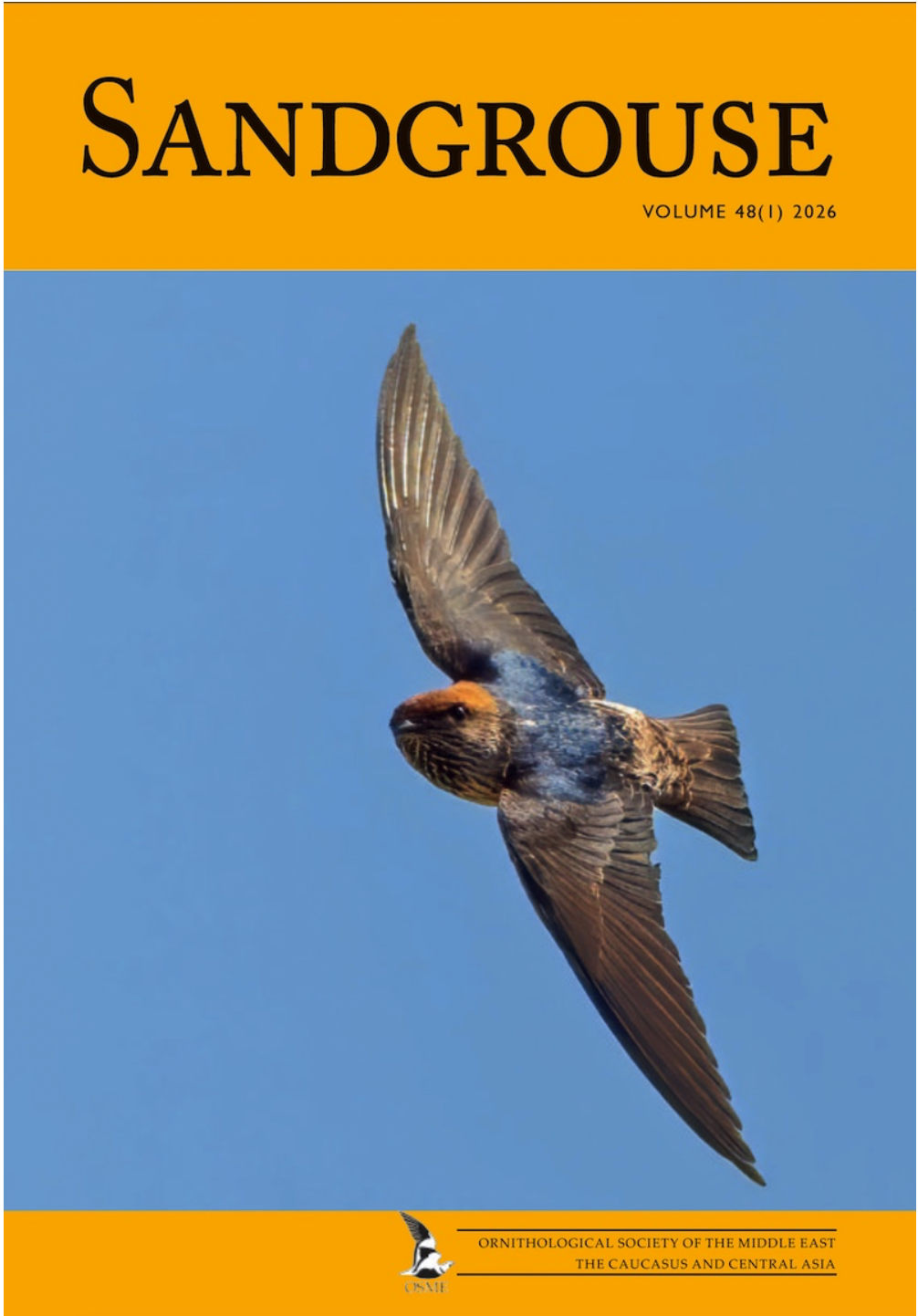
Sandgrouse volume 48 (1) Spring 2026
Ornithological Society Of The Middle East The Caucasus And Central Asia
Sandgrouse is published by OSME and contains papers and short notes on the ornithology of the OSME region, provides bird and conservation news from the region, and a comprehensive round-up of bird sightings in the Middle East, the Caucasus, and Central Asia.
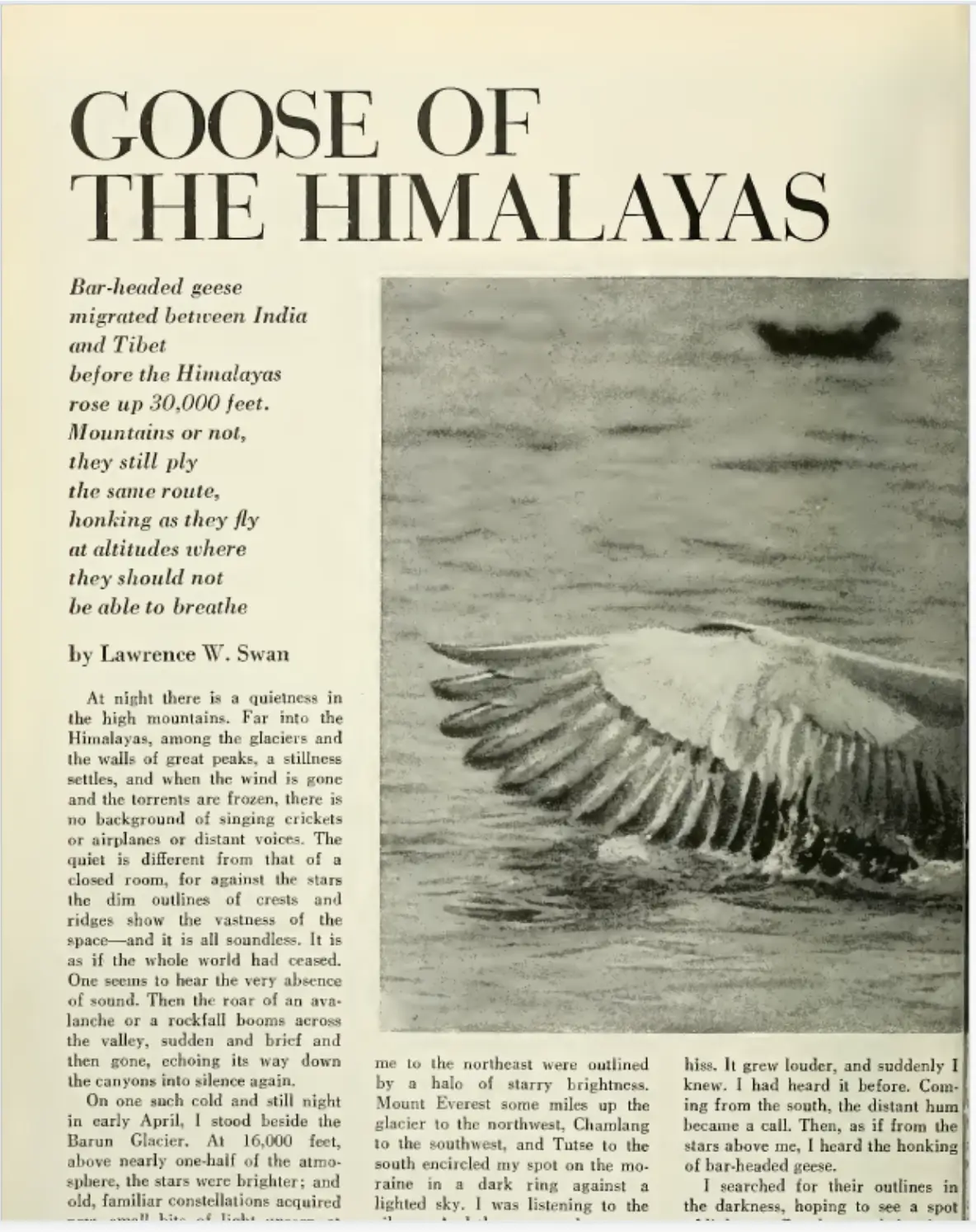
Goose of the Himalayas
Swan, L.W. 1970. Goose of the Himalayas. Natural History 79: 68–74.
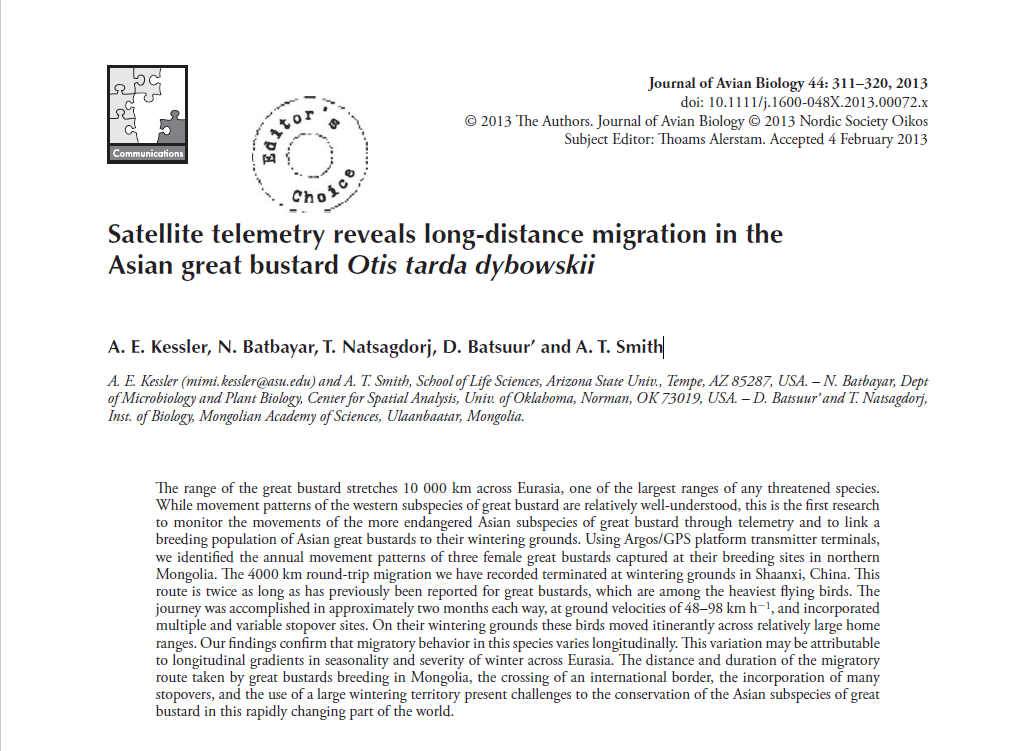
Satellite telemetry reveals long-distance migration in the Asian great bustard Otis tarda dybowskii
A. E. Kessler , N. Batbayar , T. Natsagdorj , D. Batsuur ’ and A. T. Smith
Kessler, A. E., Batbayar, N., Natsagdorj, T., Batsuur’, D., & Smith, A. T. (2013). Satellite telemetry reveals long‐distance migration in the Asian great bustard Otis tarda dybowskii. Journal of Avian Biology, 44(4), 311-320.