
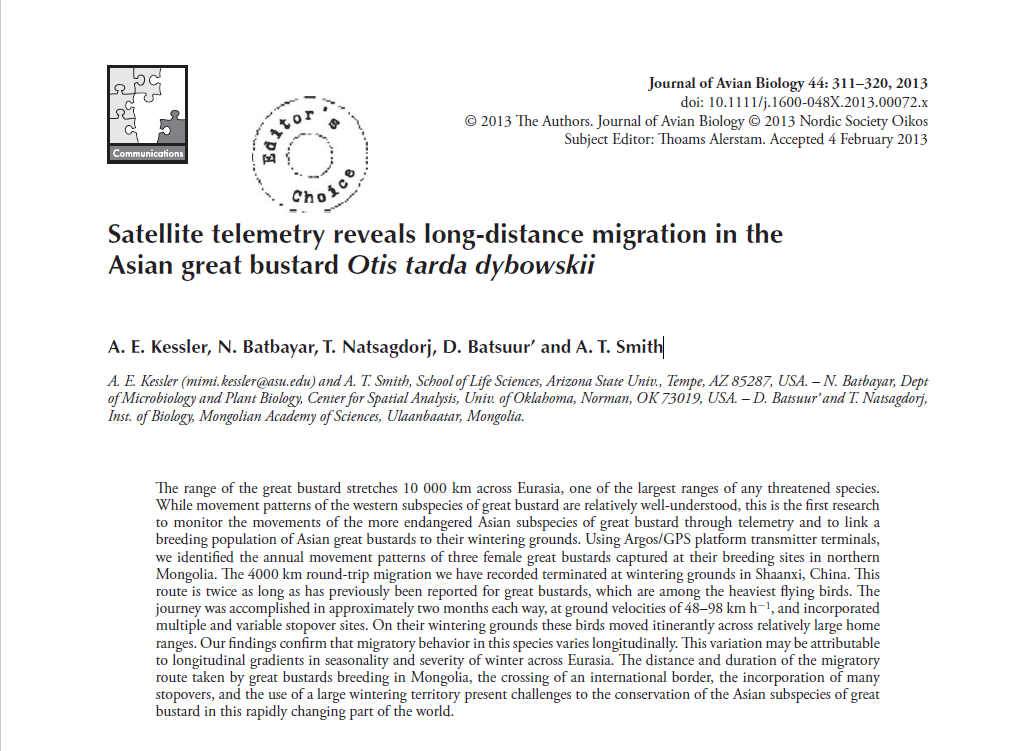
Satellite telemetry reveals long-distance migration in the Asian great bustard Otis tarda dybowskii
A. E. Kessler , N. Batbayar , T. Natsagdorj , D. Batsuur ’ and A. T. Smith
Kessler, A. E., Batbayar, N., Natsagdorj, T., Batsuur’, D., & Smith, A. T. (2013). Satellite telemetry reveals long‐distance migration in the Asian great bustard Otis tarda dybowskii. Journal of Avian Biology, 44(4), 311-320.
About this resource
Abstract: The range of the great bustard stretches 10 000 km across Eurasia, one of the largest ranges of any threatened species. While movement patterns of the western subspecies of great bustard are relatively well-understood, this is the first research to monitor the movements of the more endangered Asian subspecies of great bustard through telemetry and to link a breeding population of Asian great bustards to their wintering grounds. Using Argos/GPS platform transmitter terminals, we identified the annual movement patterns of three female great bustards captured at their breeding sites in northern Mongolia. Th e 4000 km round-trip migration we have recorded terminated at wintering grounds in Shaanxi, China. This route is twice as long as has previously been reported for great bustards, which are among the heaviest flying birds. The journey was accomplished in approximately two months each way, at ground velocities of 48 – 98 km h, and incorporated multiple and variable stopover sites. On their wintering grounds these birds moved itinerantly across relatively large home ranges. Our findings confirm that migratory behavior in this species varies longitudinally. Th is variation may be attributable to longitudinal gradients in seasonality and severity of winter across Eurasia. Th e distance and duration of the migratory route taken by great bustards breeding in Mongolia, the crossing of an international border, the incorporation of many stopovers, and the use of a large wintering territory present challenges to the conservation of the Asian subspecies of great bustard in this rapidly changing part of the world.
Related resources
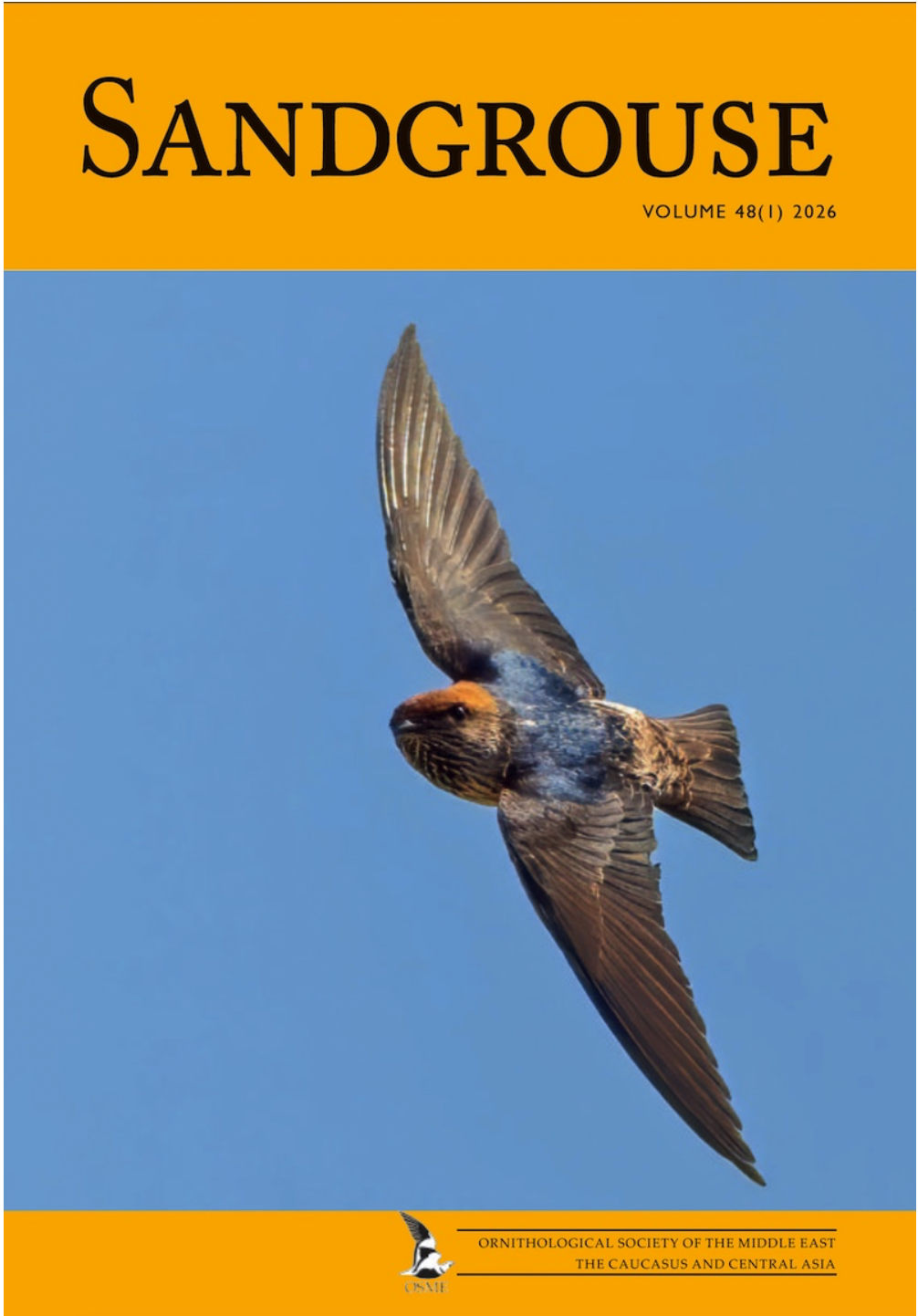
Sandgrouse volume 48 (1) Spring 2026
Ornithological Society Of The Middle East The Caucasus And Central Asia
Sandgrouse is published by OSME and contains papers and short notes on the ornithology of the OSME region, provides bird and conservation news from the region, and a comprehensive round-up of bird sightings in the Middle East, the Caucasus, and Central Asia.
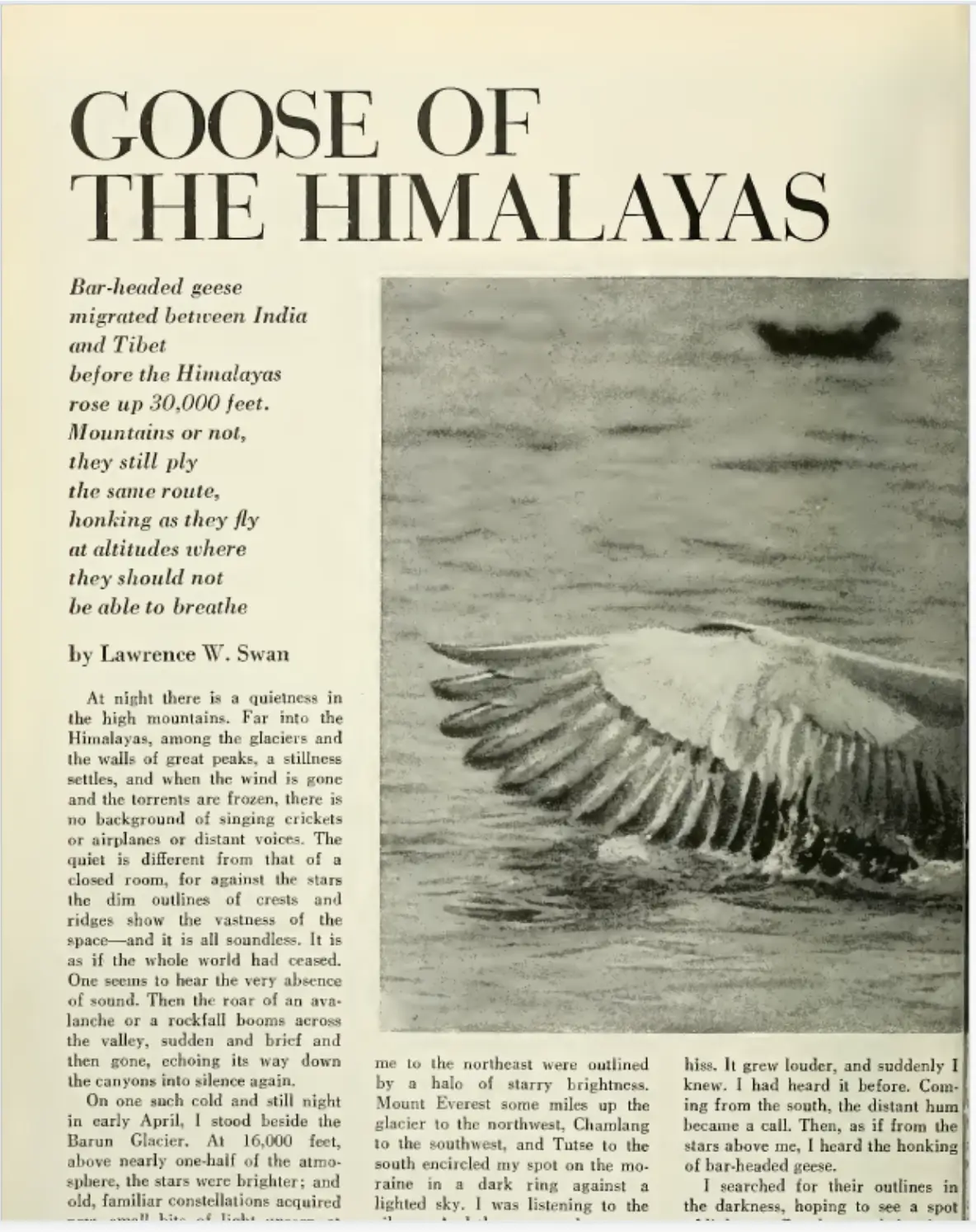
Goose of the Himalayas
Swan, L.W. 1970. Goose of the Himalayas. Natural History 79: 68–74.
The effects of powerlines on bustards: how best to mitigate, how best to monitor?
João Paulo Silva Open, Ana Teresa Marques, Joana Bernardino, Tris Allinson, Yuri Andryushchenko, Sutirtha Dutta, Mimi Kessler, Ricardo C. Martins, Francisco Moreira, John Pallett, Mattheuns D. Pretorius, H. Ann Scott, Jessica M. Shaw and Nigel J. Collar
Silva, J. P., Marques, A. T., Bernardino, J., Allinson, T., Andryushchenko, Y., Dutta, S., ... & Collar, N. J. (2023). The effects of powerlines on bustards: how best to mitigate, how best to monitor?. Bird Conservation International, 33, e30.