Event overview
In March, the Convention on Migratory Species COP15 adopted a landmark Multi-species Action Plan (MsAP) to conserve bustards – one of the world’s most threatened groups of birds. The plan establishes a coordinated, science-based global framework to protect all 26 species of bustards across 102 range states, marking an unprecedented level of international collaboration for these iconic birds.
The Central Asian Flyway is home to several bustard species, including the Critically Endangered Bengal and Lesser Floricans and Great Indian Bustard, the Endangered Great Bustard, the Vulnerable Asian Houbara and the Near Threatened Little Bustard. These species face accelerating threats, including agricultural intensification, collisions with expanding energy infrastructure, and unsustainable hunting and trade. The Central Asian Flyway community is warmly welcomed to contribute to robust and coordinated conservation action that can reduce threats and conserve these magnificent birds.
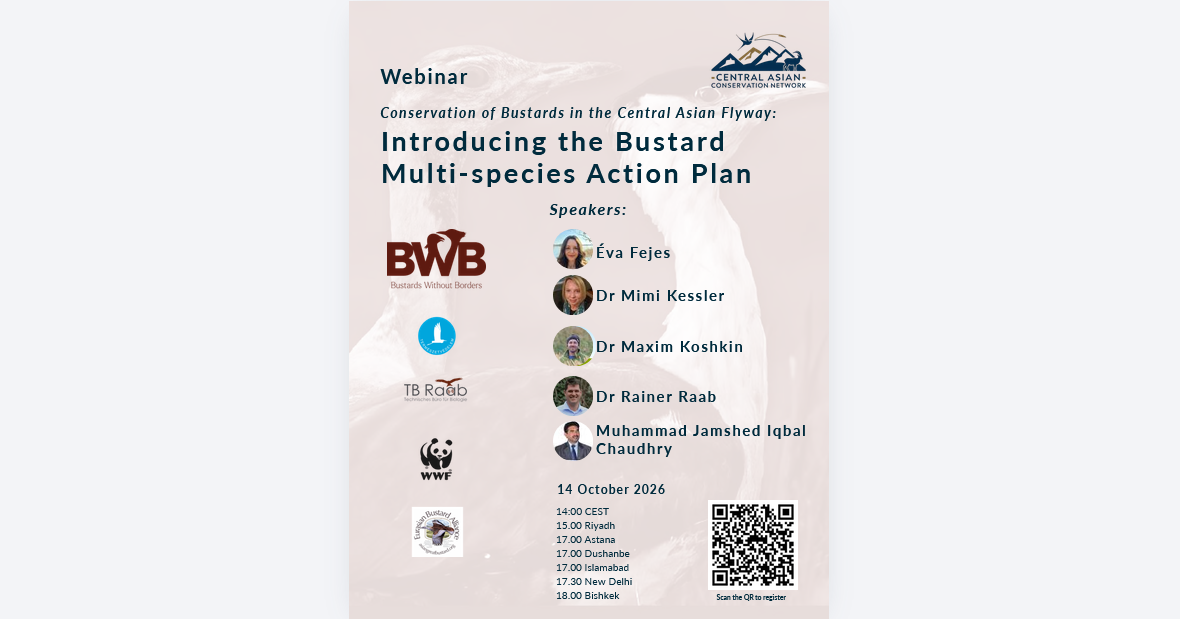
This webinar introduces the Action Plan and discusses key conservation issues for its implementation in the Central Asian Flyway region.
Speakers:
Éva Fejes - Biodiversity expert, Ministry for the Living Environment, Hungary; Co-founder & Coordination Unit member of Bustards Without Borders
Dr Maxim Koshkin - Member of the IUCN SSC Bustard Specialist Group; Coordinator for Central and East Asia, Bustards Without Borders
Dr Rainer Raab - CEO of TB Raab GmbH, Austria; Co-founder & Coordination Unit member of Bustards Without Borders
Muhammad Jamshed Iqbal Chaudhry - Sr. Manager Research & Conservation, WWF-Pakistan; Co-founder & Coordination Unit member of Bustards Without Borders
Dr Mimi Kessler - Co-chair, IUCN SSC Bustard Specialist Group; Director, Eurasian Bustards Alliance; Co-founder and Coordination Unit member of Bustards Without Borders