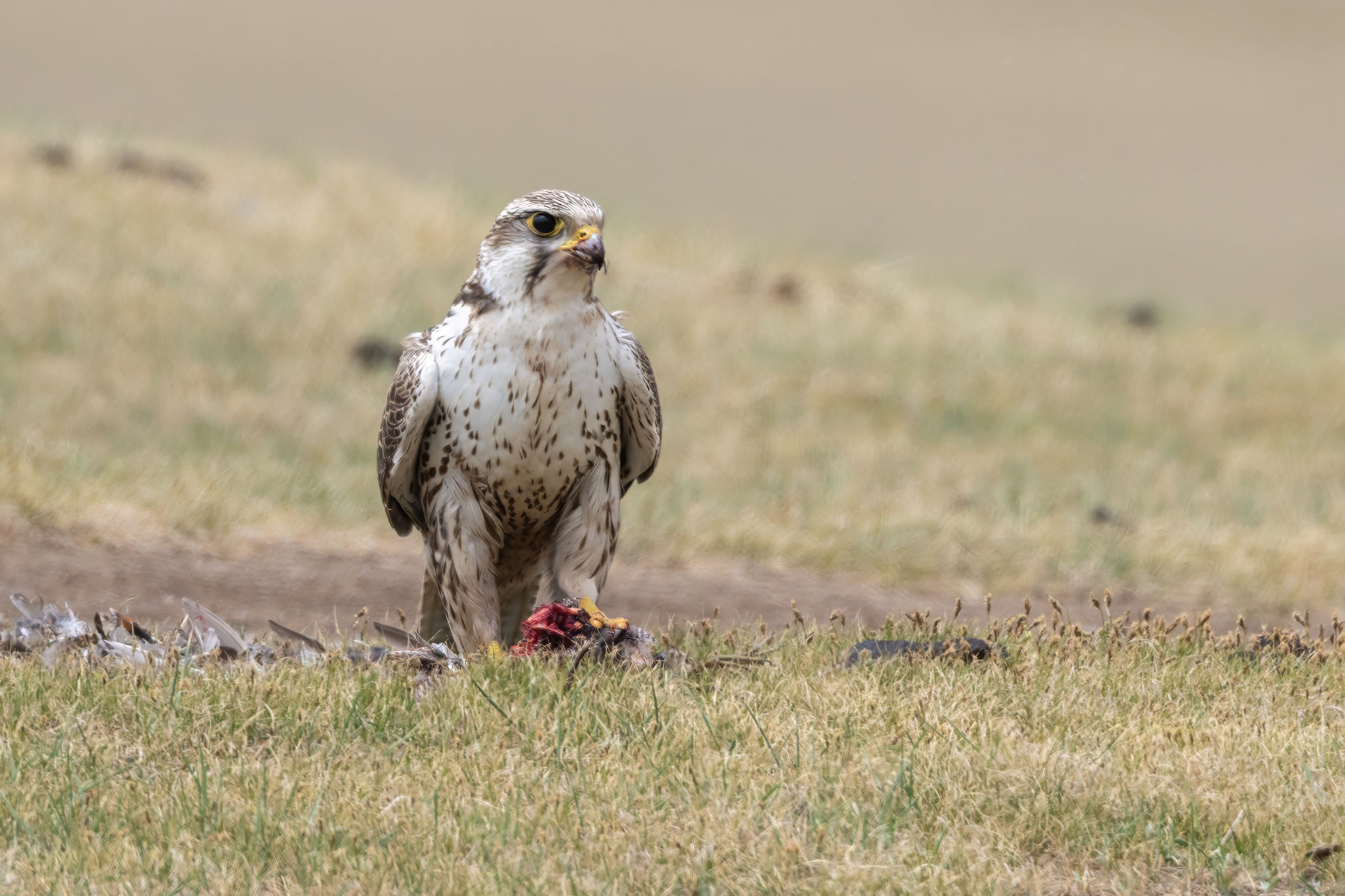
Saker Falcon (Falco cherrug)
All species
EN· Endangered
Falconidae· Falconiformes

Saker Falcon

Falco cherrug

A powerful steppe falcon whose populations are in rapid decline due to electrocution on power lines and illegal trapping for falconry. Subject of coordinated conservation action across the CAF region.

Kazakhstan Mongolia Russia Uzbekistan Turkmenistan Kyrgyzstan China

About this species

The Saker Falcon (Falco cherrug) is a large, powerful falcon of open steppes and semi-deserts, ranging from eastern Europe across the Eurasian steppes to Mongolia and China. It preys on ground squirrels, pikas, and medium-sized birds, often hunting in long, low, fast flights. Sakers are among the most prized species in traditional Middle Eastern falconry, and illegal trapping on migration routes has driven significant declines. Power-line electrocution is a second major threat, particularly in Mongolia and Central Asia. The species is the subject of the CMS Saker Falcon Global Action Plan (SakerGAP), coordinating work across range states to reduce mortality and monitor populations.

Range & migration

Breeding range

Steppe, forest-steppe and semi-desert from central-eastern Europe across Russia, Kazakhstan and Mongolia to north-east China.

Wintering range

Central Asia, the Caucasus, Iran, Arabian Peninsula, north-east Africa and the Indian subcontinent.

Migration pattern

Partial migrant. Northern populations move south to winter in Central Asia, the Middle East, North Africa and the Indian subcontinent; some populations are resident or undertake shorter nomadic movements.

Population in the CAF

Global mature population estimated at ~12,800–30,800 individuals; declining trend

Habitat

Open steppe, semi-desert and foothills; often breeding on cliffs or in stick nests of other raptors and corvids. Requires abundant ground-dwelling prey such as ground squirrels.

Threats

Illegal trapping for falconry; electrocution on medium-voltage power lines; prey loss through steppe conversion and rodent control; secondary poisoning; nest robbing.

Conservation actions

Implementation of CMS SakerGAP; national power-line retrofitting programmes (notably in Mongolia); international cooperation on trade controls; artificial nest programmes; monitoring of breeding populations.

Key sites

  • Central Mongolian steppe (breeding)
  • Ustyurt Plateau, Kazakhstan/Uzbekistan (migration & wintering)