
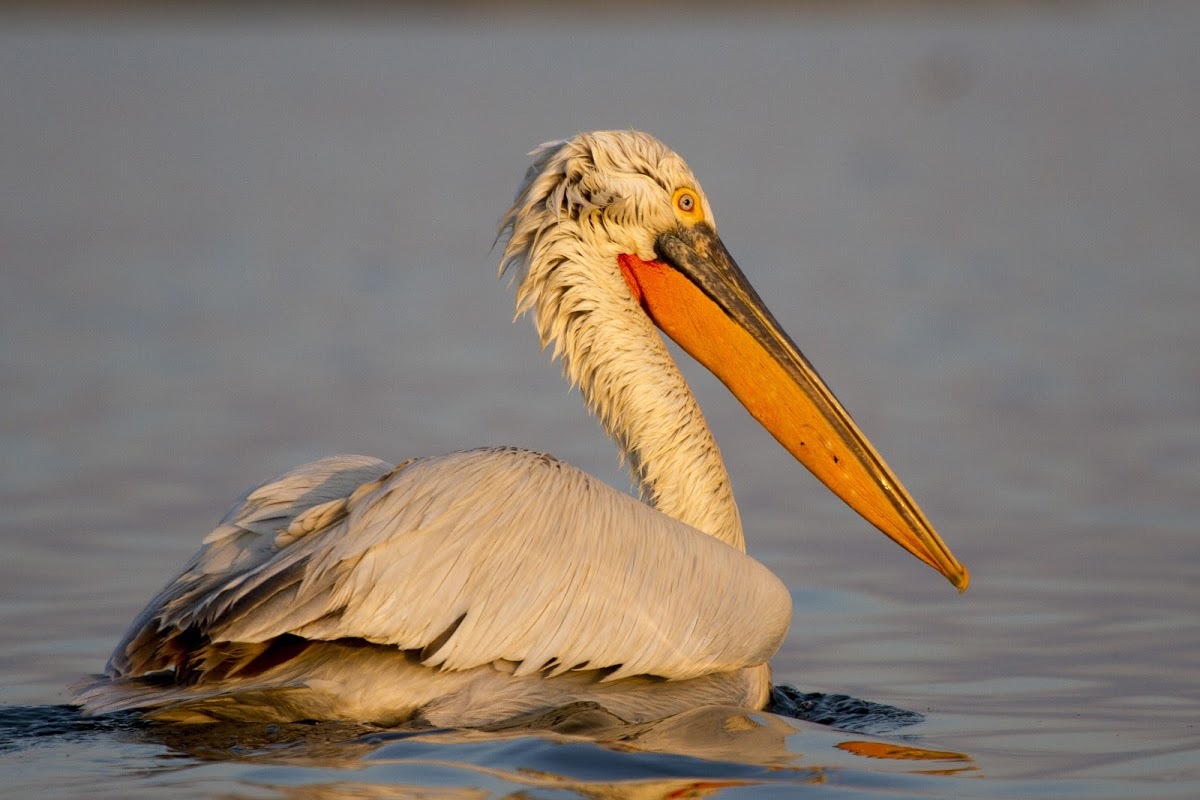
Dalmatian Pelican (Pelecanus crispus)
All species
NT· Near Threatened
Pelecanidae· Pelecaniformes

Dalmatian Pelican

Pelecanus crispus

The largest pelican species, breeding in colonies on inland lakes across Eurasia. CAF populations nest in Russia, Kazakhstan and around the Caspian Sea and winter from the Mediterranean to South Asia.

Kazakhstan Russia Turkmenistan Azerbaijan Iran India Pakistan

About this species

The Dalmatian Pelican (Pelecanus crispus) is the largest of the world's eight pelican species, with a wingspan of up to 3.5 metres. Breeding adults have silvery-grey plumage, a curly nape, and a vivid orange-red pouch. The species forms large, noisy breeding colonies on remote lake islands and reed mats, where it is highly sensitive to disturbance. In the CAF region, important breeding sites occur on lakes in Kazakhstan, Russia, and around the Caspian and Aral Seas. After severe declines in the 20th century, populations in parts of Europe have recovered thanks to colony protection and artificial nesting platforms.

Range & migration

Breeding range

Islands, reed beds and river deltas in south-east Europe, the Balkans, Turkey, the Caspian basin, and scattered sites in Kazakhstan and Mongolia.

Wintering range

Lakes, deltas and coastal lagoons from the Mediterranean to the Persian Gulf, South Asia and locally in East Asia.

Migration pattern

Short- to medium-distance migrant. Birds from the CAF region winter on the southern Caspian shores, the Persian Gulf coast, and in South Asia.

Population in the CAF

Global population ~11,400–13,400 mature individuals; CAF population in the thousands

Habitat

Large, fish-rich inland lakes, reed-fringed river deltas, and coastal lagoons. Nests in undisturbed colonies on islands or floating vegetation.

Threats

Wetland loss and water abstraction; disturbance at breeding colonies; collisions with power lines; bycatch in fishing nets; historical persecution by fisheries.

Conservation actions

Artificial nesting platforms; protected area designation (Ramsar and IBA listings); restoration of wetland water regimes; monitoring under the AEWA framework.

Key sites

  • Aydar-Arnasay Lake System, Uzbekistan
  • Lower Volga delta, Russia
  • Kyzylagach Gulf, Azerbaijan (wintering)
  • Chilika Lake, India (wintering)