
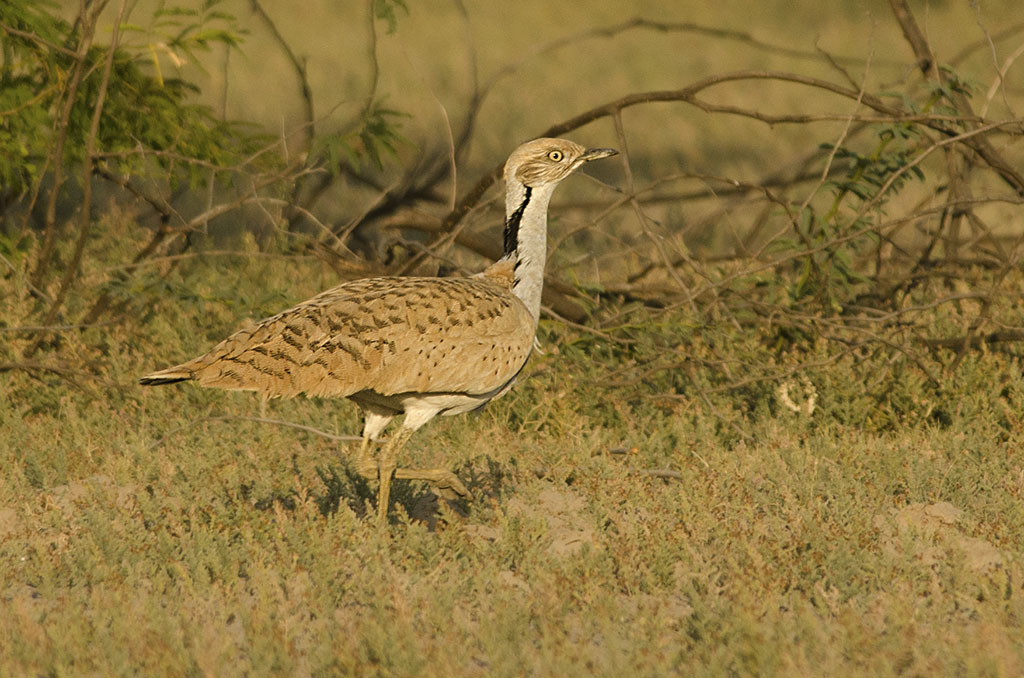
About this species
The Asian Houbara (Chlamydotis macqueenii) is a large ground-dwelling bustard inhabiting the arid deserts, semi-deserts, and steppes of the Middle East and Central Asia. Within the Central Asian Flyway (CAF), it breeds across Kazakhstan, Uzbekistan, Turkmenistan, Mongolia, and northwestern China, with migratory populations moving south to winter in Afghanistan, Pakistan, northwestern India, Iran, and the Arabian Peninsula, while populations in southwest Asia are largely resident. The species occupies open desert and semi-desert habitats with sparse vegetation and feeds on seeds, shoots, insects, and small vertebrates. Males are known for their elaborate courtship displays involving striking ornamental plumage and distinctive vocalizations. Globally classified as Vulnerable, the Asian Houbara has experienced severe population declines due to overhunting, particularly for falconry, poaching, habitat degradation, and human disturbance, despite extensive captive-breeding and release programmes aimed at supporting wild populations. The Asian Houbara is one of the most culturally significant birds of the Central Asian Flyway, prized for centuries as the traditional quarry of falconry and deeply embedded in the nomadic heritage of Central Asia and the Arabian Peninsula.